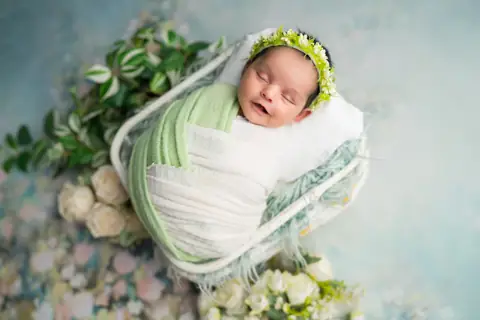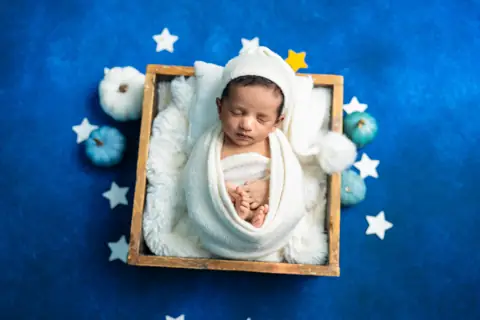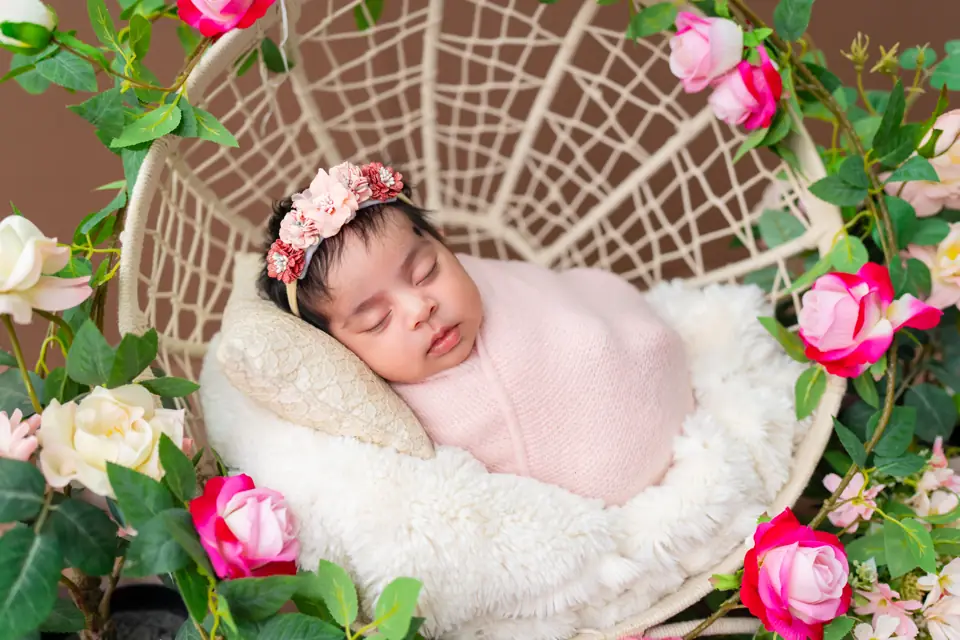
Photos of tiny sleeping newborns in baskets and on crescent moons are beautiful — and it's completely natural to look at them and wonder, "Is that actually safe?" You're right to ask. A newborn can't hold up their own head, can't tell us they're cold, and can't move away from something uncomfortable. The safety of the session depends entirely on the photographer.
The short answer
Yes — when it's done by a trained newborn photographer who puts the baby's comfort before every photo. The checklist below will help you tell the difference. You can use it with any photographer you're considering, including us.
1. Has the photographer trained specifically in newborn safety?
Newborn posing is a specialist skill. General photography experience is not the same as knowing how to position a baby's joints, support their airway and read their cues. Ask where the photographer trained. Srikanth, who photographs every newborn session at SriPhotography, is certified by Mommy Shots Academy and Ana Brandt Education, both of which focus on newborn posing and safety.
2. Are "impossible" poses made as composites?
Some famous newborn poses — like a baby with their chin resting on their hands, or a baby apparently hanging in a little sling — are never taken in a single shot. A safe photographer takes two or more photos with an adult hand supporting the baby's head, wrists or body in each one, then carefully combines them in editing so the hands disappear. The baby is never balancing on their own.
If a photographer says they don't need composites for these poses, that's a red flag.
3. Is there always a hand close to the baby?
Newborns startle suddenly. In a safe session, a hand is on or right beside the baby in every raised or propped setup — this is called "spotting". The hand is then edited out of the final photo. Babies are never left alone on a prop, even for a second.
4. Is the room kept warm, but not too warm?
Newborns can't regulate their body temperature the way adults can, so a baby who is partly unwrapped for photos needs a warmer room than usual. At the same time, overheating is also a risk for babies. A good photographer keeps the room comfortably warm, checks the baby's skin often and adjusts — sweating, flushed cheeks or damp skin mean the baby is too hot, while cool, mottled skin or fussing can mean they're too cold. (See the medical sources at the end for more on how newborns manage temperature.)
5. What's the hygiene routine?
Your baby's immune system is still developing. Ask what happens between sessions. At our studio:
- Wraps and fabrics that touch your baby are washed after each session
- Props are sanitised between babies
- Hands are washed before handling your baby, every time
- Anyone unwell — including us — doesn't come near the baby; we'll reschedule instead
6. Does the session follow the baby's pace?
A rushed newborn session is an uncomfortable one. Expect breaks for feeding, changing and cuddles. If a baby is unsettled in a pose, a good photographer moves on rather than forcing it. This is also why newborn sessions take a few hours — the time is for the baby, not the photos.
7. Can parents stay close?
You know your baby better than anyone. You should always feel welcome to stay nearby, ask questions and step in to feed or comfort your baby. A photographer who wants parents out of the room is not someone to trust with your newborn.
8. Are props stable and baby-safe?
Props should be sturdy, low, padded and weighted where needed. Glass, sharp edges, real flames and anything raised high without support have no place in a newborn session. Many "high" looking setups are actually low to the floor, or are composites.
Red flags to watch for
- No specific newborn training, or vague answers about it
- "We don't need composites — babies can hold that pose"
- Pressure to keep going when your baby is upset
- A cold room, or no questions asked about feeding and health
- Parents asked to wait outside
How we work at SriPhotography
Everything above is simply how we run every newborn session at our studio in Neredmet and in families' homes across Hyderabad. We've photographed more than 1,500 newborns since 2019, and the rule has never changed: the baby comes first, the photo second. You can see how a session flows on our newborn photography page, or read our newborn photoshoot planning guide for timing and preparation.
Ask us anything about safety
Nervous about a first newborn session? Message us on WhatsApp — we're happy to explain exactly how we'd look after your baby.
Sources
- Children's Hospital of Philadelphia — Warmth and temperature regulation
- UT Southwestern Medical Center — Keeping newborns at just the right temperature